
Earthquakes and Ecosystems: The Invisible Impact of Seismic Activity on the Environment
When we think of earthquakes, the human mind immediately conjures up scenarios of collapsed urban infrastructure, socioeconomic losses, and civil emergency challenges. Yet, beyond the paved areas of our cities, seismic waves exert a profound, transformative force on the natural environment. Earthquakes alter the landscape, modify water resources, destroy critical habitats, and trigger massive biological imbalances that may take decades to stabilize.
For a geologically dynamic region like the Caribbean, understanding these environmental impacts is not merely an academic exercise but a fundamental pillar for land-use planning, sustainable development, and biodiversity conservation.
What Can Be Done? Responses from Environmental Management and Engineering
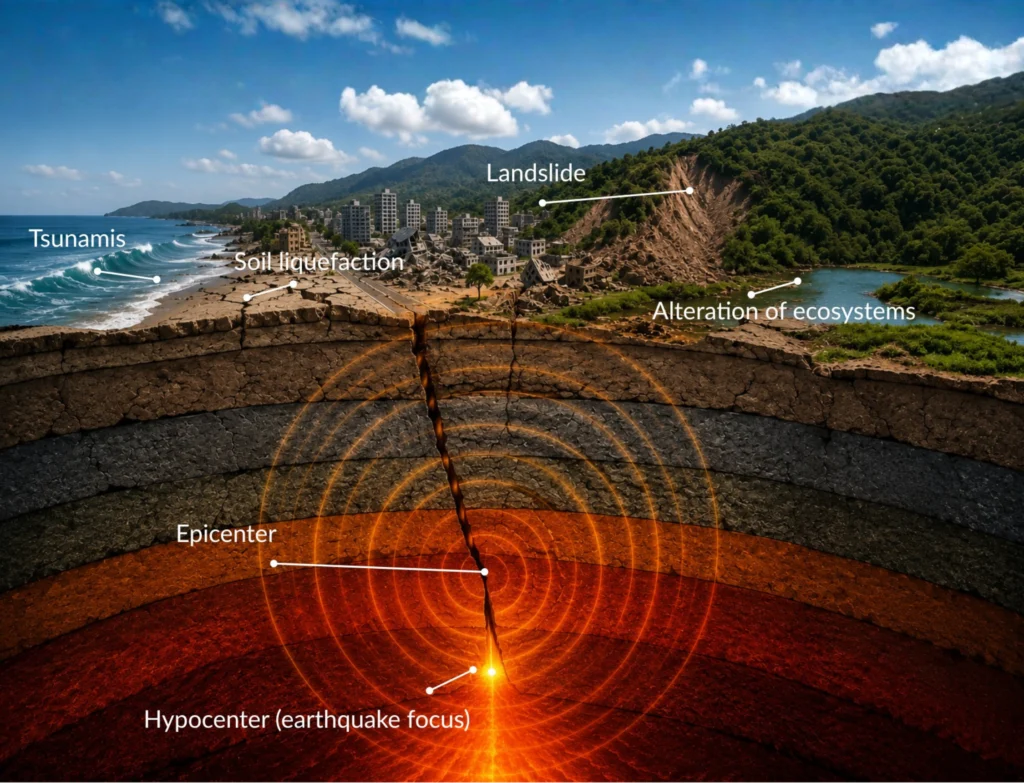
While earthquakes are unavoidable natural phenomena, secondary environmental impacts and associated industrial risks can be mitigated through a robust strategy of environmental management and corporate resilience:
Environmental Vulnerability Assessments: Integrate seismic risk analysis into Environmental Impact Assessments (EIAs). Understanding local geology makes it possible to predict which conservation or buffer zones are most prone to landslides or liquefaction.
Industrial Disaster Contingency Plans: An earthquake can rupture storage pipelines and industrial infrastructure, triggering severe environmental emergencies. It is critical to design and conduct rigorous field drills—such as training on spill control deployment in riparian and coastal zones—to ensure an immediate technical response to accidental leaks caused by seismic activity.
Post-Event Environmental Monitoring: Following a major earthquake, it is essential to carry out technical monitoring campaigns for water, air, and soil quality. This allows for the identification of released contaminants, physicochemical changes in water sources, and the extent of habitat degradation, enabling the coordination of timely ecological remediation plans.
Nature-Based Ecological Restoration: Reforesting upper watersheds with native, deep-rooted species stabilizes soils prone to landslides triggered by tectonic vibrations, thereby protecting both biodiversity and downstream infrastructure.
Our Commitment at Kaizen
At Kaizen Environmental Services Trinidad Limited, our vision of operational excellence drives us to champion sustainability directly in the field. Through our specialized divisions—including Environmental Consulting, Project Services, Civil Works, EnviroProducts, and Waste Services—we provide the technical capabilities, real-time analytical monitoring, and emergency response preparedness needed to mitigate industrial risks and protect our nation’s ecological wealth against the challenges of a dynamic natural environment.